Briefing · August 11, 2026
Gateway Is Dead, Long Live the Lunar Base: What Northrop and CSA's Pivot Means for Surface Power
Northrop Grumman and the Canadian Space Agency are repurposing Gateway hardware for a lunar base, forcing a hard rethink of surface power architectures.
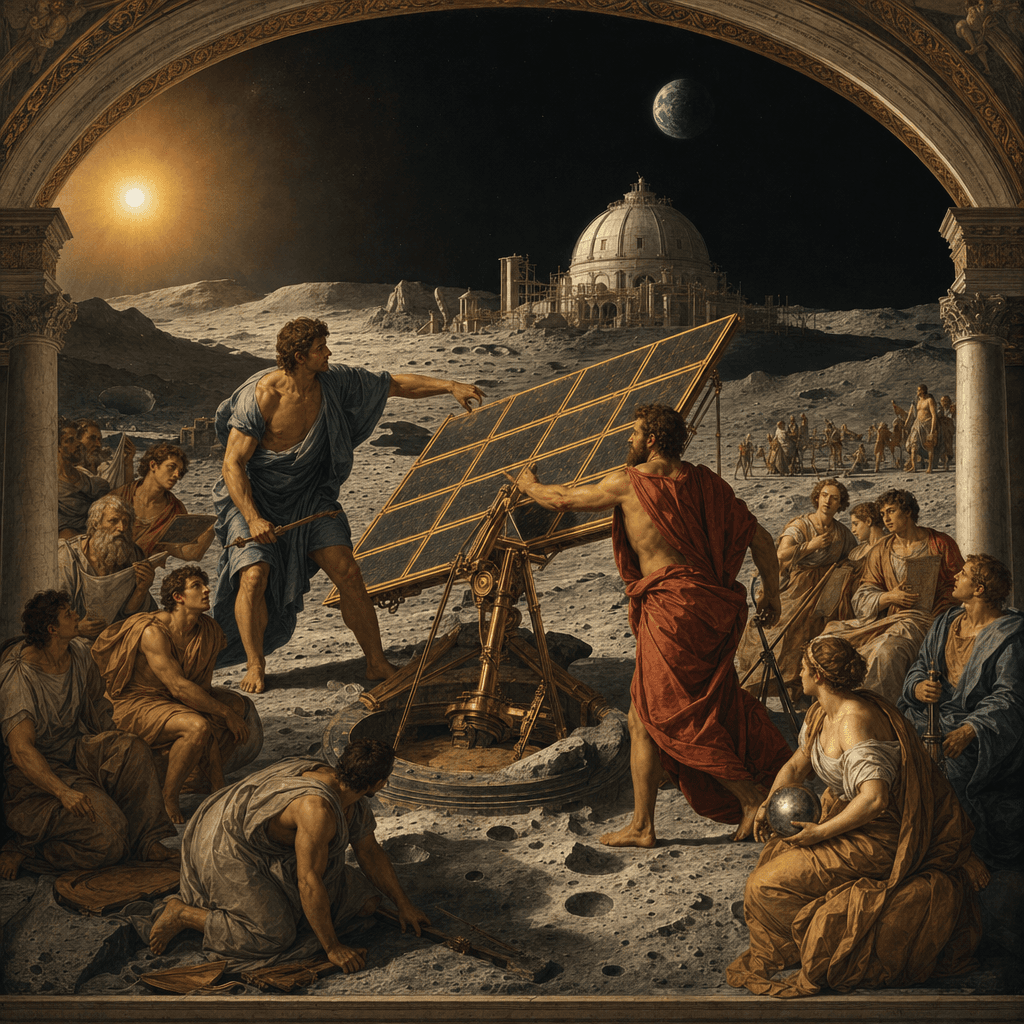
The program-of-record just shifted underneath lunar surface power planners. Northrop Grumman and the Canadian Space Agency (CSA) announced they will repurpose hardware originally developed for NASA's lunar Gateway into systems targeting a planned lunar base — with few specifics attached to the pivot, but with major implications for the power-on-worlds beat that readers of this briefing track closely.
The core finding, stated plainly: Northrop Grumman and the Canadian Space Agency are redirecting Gateway-era lunar infrastructure work toward a surface base architecture, as confirmed by SpaceNews (2026-08-01), a move that simultaneously orphans power systems designed for cis-lunar station-keeping orbits and opens procurement space for lunar-surface-specific power solutions.
What exactly changed with Gateway, and why does it matter for power?
Gateway was designed as a lunar-orbit outpost, which shaped every subsystem — including power. The Gateway Power and Propulsion Element (PPE) was sized for the unique solar flux and thermal environment of a near-rectilinear halo orbit (NRHO), where a spacecraft sees near-continuous sunlight. A surface base, by contrast, must survive the lunar night: 14 Earth-days of zero solar input at permanently shadowed or mid-latitude sites. That is not a tweakable parameter — it is a full architecture reset. Systems originally scoped for the Gateway cannot simply be bolted to regolith and declared operational.
The SpaceNews (2026-08-01) report confirms the repurposing intent but offers no wattage targets, no technology readiness level (TRL) ratings, and no delivery timelines for the adapted hardware. For program officers and investors, that absence of numbers is itself a data point: this pivot is still at the concept stage, not a bankable milestone.
How does this fit into NASA's broader Artemis surface power roadmap?
NASA's Artemis program has been assembling a commercial robotic lunar mission cadence that, in principle, will validate surface systems before crew arrive, according to NASASpaceFlight.com (2026-08). The agency has pursued a Fission Surface Power (FSP) project targeting a 10 kWe-class reactor deliverable to the lunar south pole by the early 2030s — a separate track from solar. That FSP track gains strategic importance precisely because Gateway's solar-centric heritage hardware is now being redirected rather than directly inherited by surface planners.
Evergreen explainer — lunar surface power in one paragraph: Lunar surface power (LSP) refers to electrical energy generated and stored at or near the Moon's surface to support habitat life support, in-situ resource utilization (ISRU), and mobility charging. The fundamental challenge is the lunar diurnal cycle: at non-polar sites, a solar array produces power for roughly 354 hours, then goes dark for another 354 hours. Bridging that gap requires either massive electrochemical storage, a fission reactor, or siting at polar peaks of near-eternal light — each carrying distinct mass, cost, and TRL penalties. Specific power (watts per kilogram, W/kg) and energy storage round-trip efficiency are the two numbers that determine whether any given architecture is credible.
What should procurement teams watch next?
Three concrete decision gates now matter more than the Gateway pivot announcement itself.
First, watch whether Northrop Grumman files any formal proposal response tied to NASA's ongoing Lunar Surface Power solicitations or whether the CSA component maps to Canada's Artemis contribution commitments. The announcement as reported by SpaceNews (2026-08-01) contains no contract vehicle, no dollar value, and no agency acceptance — making this a letter of intent at best.
Second, track the Artemis commercial robotic lander manifest through NASASpaceFlight.com (2026-08). Each robotic precursor mission that carries a power technology demonstrator — whether a solar array, a fuel cell, or a small fission unit — advances the TRL ladder that any surface base hardware must climb before crew commitment.
Third, the absence of a firm site selection for the lunar base means power architecture comparisons (polar solar vs. mid-latitude fission vs. hybrid) cannot yet be closed. Specific power targets, cable-run distances, and thermal rejection areas all vary dramatically between a south-pole ridge site and a mid-latitude lava tube entrance.
For investors considering positions in lunar power startups, or program officers evaluating whether Gateway-heritage partnerships are worth preserving, the Northrop-CSA pivot signals that the field is genuinely open — but that openness cuts both ways. No incumbent has a locked-in surface power contract, and no architecture has been selected. The next bankable milestone will be the first demonstration of sustained kilowatt-scale power delivery through a full simulated lunar night, at a credible W/kg figure, in a flight-like thermal environment. That milestone has not yet been claimed by anyone.
Created with AI assistance. Editorial oversight: Juergen Ritzek. See our AI disclosure.