Briefing · August 6, 2026
NASA's Moon Base Cargo Push: Four Landers, One Power Problem That Still Needs Solving
With four commercial landers targeting 2028 lunar delivery and a navigation payload already integrated, the Moon Base program is real — but surface power remains the open variable.
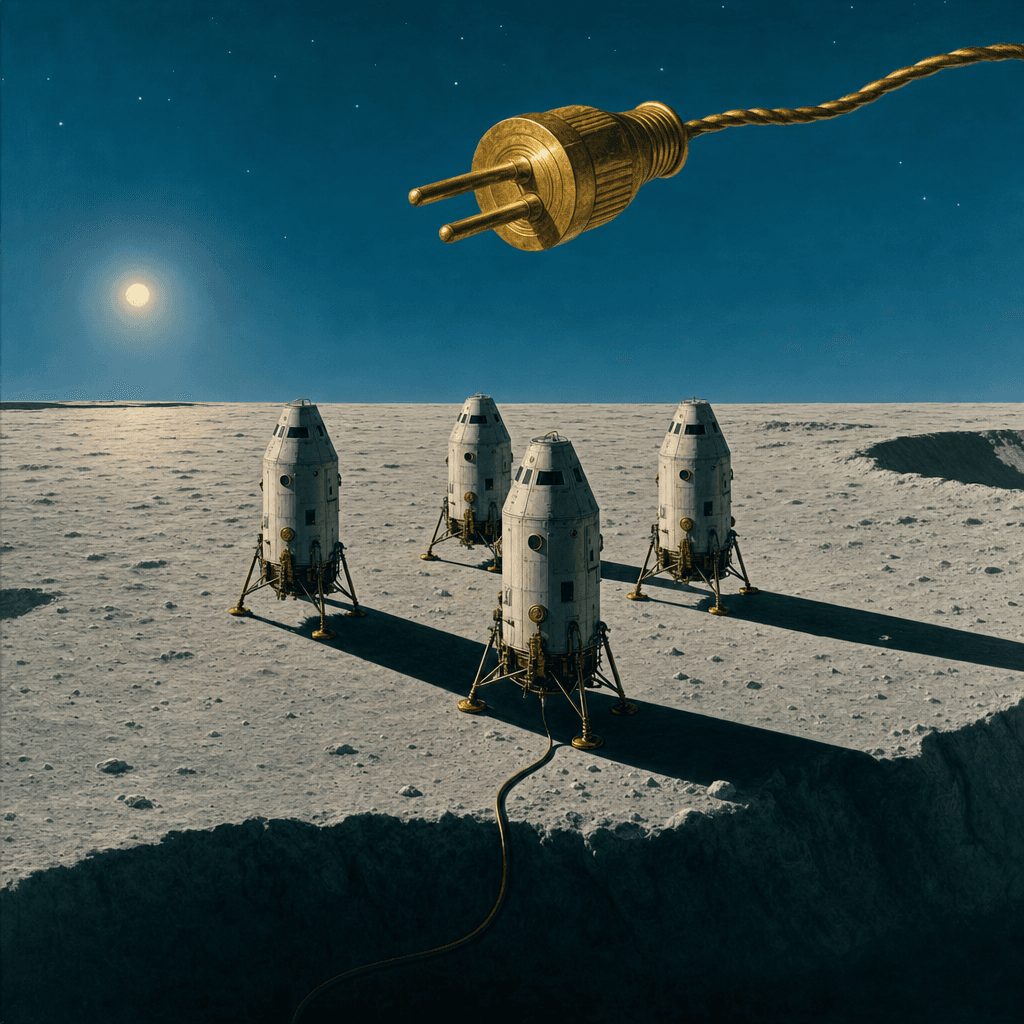
What exactly is NASA's Moon Base cargo lander plan?
NASA's Moon Base program — a planned resilient outpost near the lunar South Pole intended to support science, technology, and eventual human operations — has moved from architecture slides to signed commercial partnerships. NASA (2026-07) confirmed that four commercial partners — Blue Origin, Firefly Aerospace, Intuitive Machines, and Voyager Lunar Systems — are under contract to deliver cargo landers targeting 2028 as the delivery window. That is a specific, near-term commitment, not a decadal aspiration.
To place that milestone on the demo-to-deployment curve: cargo delivery by 2028 proves logistics, not habitability. The South Pole surface environment — roughly 88 hours of lunar night at some latitudes, regolith temperatures swinging below minus 170 °C, and no terrestrial grid to draw from — demands a dedicated surface power architecture before any sustained operations are possible. The landers are necessary; they are not sufficient.
One self-contained finding that deserves to stand on its own: NASA's Moon Base program has four commercial partners under contract to deliver lunar South Pole cargo landers by 2028, a milestone that advances logistics infrastructure but leaves surface power — the critical enabling variable for sustained human operations — still to be demonstrated at scale.
What is lunar surface power, and why does it matter for the Moon Base timeline?
Lunar surface power is the discipline of generating, storing, and distributing electrical energy on the Moon without access to Earth's atmosphere, magnetic field, or grid. The primary technology candidates are fission surface power (FSP) systems — compact nuclear reactors designed to produce 10 kilowatts electric (kWe) continuously regardless of solar angle — and solar-plus-storage arrays that must survive the roughly 14-Earth-day lunar night. A smart newcomer can think of it this way: the Moon Base is a remote Antarctic station where the nearest re-supply is a multi-day rocket flight and the power grid must be brought from scratch.
The FSP option remains at Technology Readiness Level (TRL) 4–5 as of mid-2026, meaning key components have been validated in laboratory environments but no integrated system has been tested in a relevant space environment. Solar-plus-storage faces a different constraint: the mass penalty of batteries or regenerative fuel cells capable of bridging a 336-hour lunar night is severe at any realistic launch cost per kilogram.
How does the NavCube3-mini delivery change the near-term picture?
On July 13, 2026, NASA (2026-07) delivered the NavCube3-mini payload to Intuitive Machines for integration into Altus-1, the company's first lunar relay satellite. NavCube3-mini is described as roughly half the size of its predecessor, a form-factor reduction that matters for mass-constrained lunar orbiters. The relay is designed to provide communications and navigation services for astronauts and rovers operating at the Moon Base — meaning the navigation infrastructure layer is now ahead of the surface power layer on the readiness curve.
That asymmetry is worth flagging for program officers and investors: you can navigate a site you cannot yet keep warm through the night. The communications milestone is real progress; it just sharpens the urgency of the power question rather than answering it.
What the cost signal means for the broader roadmap
Separately, Space News (2026-07) reported that converting an engineering model of a Mars rover into an actual lunar rover could cost NASA more than 1 billion USD — an estimate the agency's administrator publicly rejected. Whether the final number lands at 500 million USD or 1.2 billion USD, the data point illustrates a structural reality: lunar surface hardware is expensive to adapt, certify, and fly, even when you start with an existing design. Any surface power system that requires custom lunar qualification faces the same cost pressure.
For space solar and power-beaming teams watching the Moon Base program: the 2028 lander cadence creates a credible demand signal, but the payload mass budgets and cost ceilings that commercial landers will impose are tightening constraints, not relaxing ones. A fission surface power unit or a deployable solar array that cannot meet a competitive price-per-kilowatt-delivered-on-surface will not make the manifest. The near-term decision for anyone developing lunar surface power technology is whether their system can pass a 2027 system-level demo in time to be considered for the first operational cargo flights — because after 2028, the manifest will already be written.
Created with AI assistance. Editorial oversight: Juergen Ritzek. See our AI disclosure.